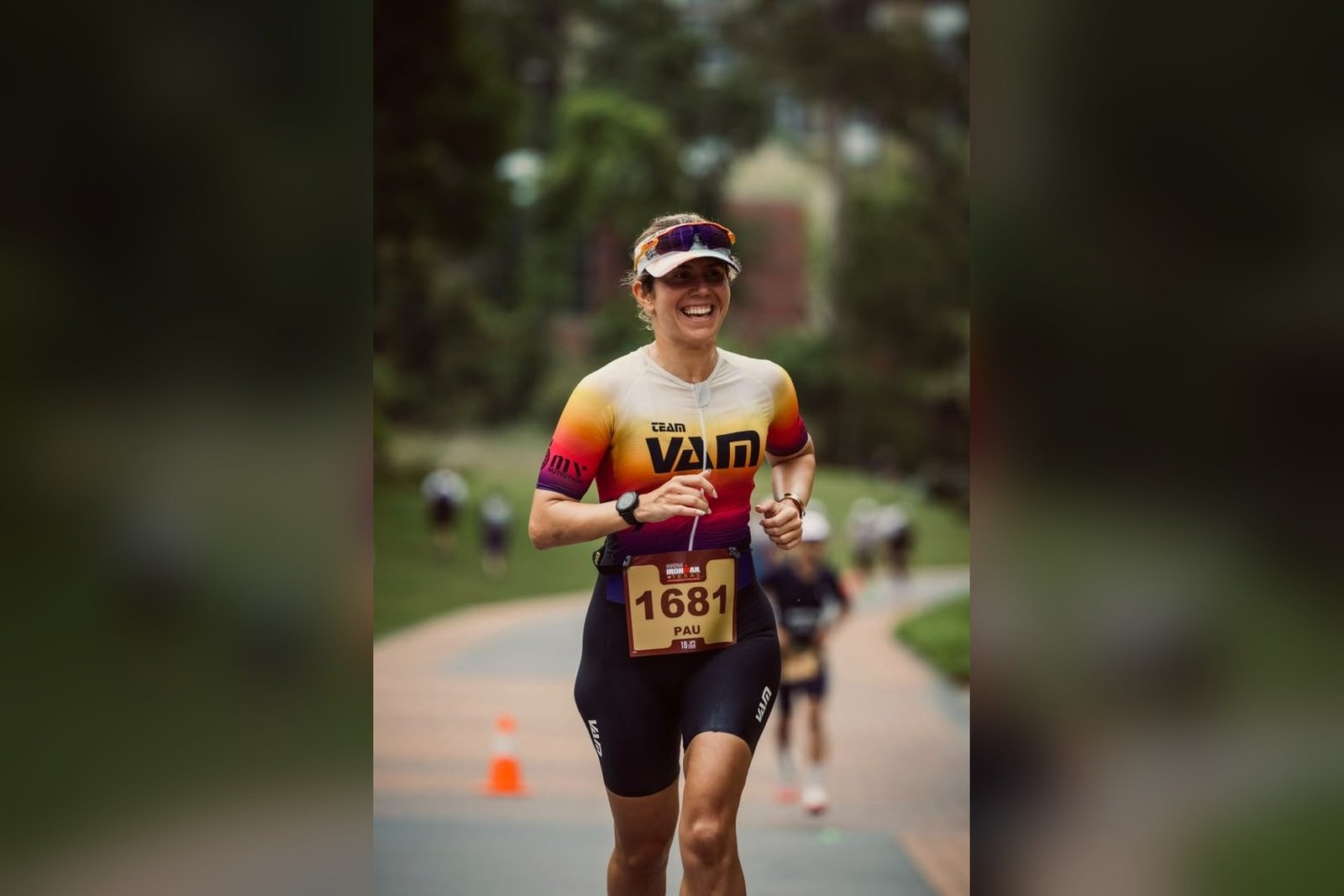
There's a deeply held belief in triathlon: that to finish a full IRONMAN you basically have to live to train. Twenty hours a week, endless early mornings, a social life on hold. It's one of the reasons so many people who dream of crossing that finish line never even sign up. They look at their calendar, do the math, and decide they simply don't have the time.
Pau's story shows that the equation is set up wrong. On April 18, 2026, Pau completed her first full-distance IRONMAN at the Memorial Hermann IRONMAN Texas in The Woodlands — the North American Championship of the distance, no less. And she did it training fewer hours than most people think is required, on a plan built around her job and lifestyle, not against them.
Her splits speak for themselves:
- Swim (2.4 mi): 1:15
- Bike (112 mi): 5:00
- Run (26.2 mi): 4:05
- Finish time: 10:30:00
For a debut at the distance, on a championship-level course, a 10-hour, 30-minute finish is the mark of an athlete who arrived on race day well prepared and well paced. And here's the part that surprises most people: she got there without a single brick session, without a single run longer than two hours, and with her swim as the foundation of the whole plan. Here's what made it possible.
The starting point: a real athlete with a real life
Pau didn't start from scratch. She already had a couple of 70.3s (half IRONMAN) under her belt, so she knew what it felt like to race long and had an aerobic base in place. But the half and the full IRONMAN are different animals. Double the distance doesn't mean double the demand — it means a different kind of demand entirely. Accumulated fatigue, in-race nutrition, and above all the ability to hold your pace through the final hours are challenges that simply don't show up in a 70.3.
The other key fact is that Pau works. Like the vast majority of our athletes, her training had to coexist with workdays, commitments, and recovery. We didn't have twenty hours a week to spread around. And far from being a problem, that was the starting point of the plan.
The methodology: build the plan around the life, not the other way around
At MP Endurance we start from a principle we repeat in every process: quality over quantity. It's not about how many hours you train — it's about what each of those hours does for you. With Pau, the work began with a question that most generic plans never ask: how much time do you actually have, and when?
From there, the plan was built on four pillars:
1. Availability first
We mapped her real week — not an ideal week — and identified the windows where she could train consistently and sustainably. A plan that doesn't respect your schedule is a plan you'll abandon. Consistency over the months matters far more than one heroic week followed by three weeks of guilt and fatigue.
2. Swimming as the foundation
This is where we put the base of the whole build. The swim is the leg where most age-group triathletes lose the most time and energy — and where good technique pays off more than raw fitness. Rather than chasing volume across all three disciplines, we made improving Pau's swim the cornerstone of the plan. A more efficient, more economical swim meant she came out of the water in Lake Woodlands having spent less energy, leaving more in the tank for the bike and the run. Her 1:15 swim split wasn't luck; it was the part of the plan we invested in first.
3. Every session with a purpose
Zero junk miles. When time is limited, there's no room for a single session without a goal. Every one of Pau's workouts had a clear intention: develop threshold, build aerobic base in Zone 2, work on running economy, or specifically prepare for the demands of race day. Using power, heart rate, and pace data, we adjusted the load in real time so every hour invested paid off to the fullest.
4. Smart specificity — without the traditional volume
Here's where Pau's preparation breaks with what most people picture. We didn't do brick sessions (bike and run back to back), and we never ran longer than two hours in training. The conventional IRONMAN playbook leans heavily on both, but for an athlete with limited time, that volume carries a high cost in fatigue and recovery for a return that can be achieved more efficiently other ways. Instead, we prepared her body for race day through targeted sessions, controlled intensity, and a nutrition and pacing strategy rehearsed without burning her out. When April 18 arrived, she was fresh, not flattened by months of mega-sessions.
Why this matters for you
Pau's result isn't the exception that proves the rule. It's exactly what our methodology is designed to demonstrate: an athlete training under the right coaching can train fewer hours and still perform well in their age group.
The difference isn't volume. It's precision. A personalized plan that respects your availability, assigns each session a concrete physiological purpose, and adapts to your real data gets more out of 8 or 10 well-used hours a week than out of 18 poorly distributed ones.
That completely changes who can aim for a goal like IRONMAN. You don't have to be a professional or put your life on hold. You need a smart plan and the consistency to follow it. Peak performance isn't a privilege reserved for those with unlimited time — it's within reach of anyone willing to train the right way.
Ready for your own goal?
If you see yourself in Pau's story — a big goal in mind but a calendar that seems to leave no room for it — that room probably exists. It just has to be designed well.
At MP Endurance we're triathlon and running coaches in Miami, and we build IRONMAN, marathon, and triathlon plans around each athlete's real life, with a data-driven approach through TrainingPeaks.
Request your assessment and let's start planning your next finish line.
Ready for High-Performance?
Expert endurance programming for your first finish line or next PR.
Start Your Assessment